
Feeling overwhelmed by Jeddah’s relentless pace and the mental fog creeping into your 2026 goals? You’re not alone—many women here chase calm but end up exhausted by fleeting fixes. This guide hands you a practical Pilates roadmap for true mental well-being, backed by research showing significant reductions in anxiety and depression after consistent practice.
Why 2026 Feels Different
It’s late December 2025. The holiday rush is peaking, the year is wrapping up, and everyone is starting to talk about resolutions. Usually, the conversation revolves around weight loss or intense gym schedules. But after the year we’ve had, the vibe in Jeddah feels different. We aren’t just looking to get smaller; we’re looking to feel calmer.
If you are feeling burnt out or mentally cluttered, you aren’t alone. That’s why my focus for 2026 isn’t just physical fitness—it’s mental resilience. Pilates has become my anchor here in Saudi Arabia, and it might be the tool you need to navigate the coming year with a clearer head.
The Science: How Pilates Actually Improves Mental Health
We often treat mental health and physical fitness as separate to-do lists. You go to therapy for your mind and the gym for your body. But Pilates bridges that gap, creating a single practice that addresses both.
The research is compelling. A 2024 systematic review found that Pilates led to significant reductions in depression, anxiety, and stress levels in both clinical patients and healthy adults. The effects were substantial—studies documented percentage reductions ranging from 11% to 81% in depressive symptoms and 33% to 46% in anxiety across different trials.
Another meta-analysis of controlled trials showed large reductions in both depressive and anxiety symptoms after Pilates interventions. Perhaps most importantly for busy professionals, a 2024 study found that even a weekly Pilates program produced significant mental health benefits—documenting how a three-month weekly protocol can effectively manage stress, anxiety, and depression.
What Pilates for Mental Well-Being Actually Means
When I say “Pilates for mental well-being,” I don’t mean lighting a candle and hoping for the best. I mean using specific physical resistance to train your nervous system. It’s about learning how to stay calm when your muscles are shaking and your instinct is to quit. This physical resilience translates directly to emotional regulation outside the studio.
The mechanism is clear: you are actively lowering your cortisol levels with every controlled movement. You are teaching your body that it can handle stress without panicking.
How Pilates Rewires Your Mind for Calm and Clarity
The magic of Pilates happens in the nervous system. Unlike high-intensity interval training that can spike cortisol, Pilates works to soothe the “fight or flight” response. It requires a level of concentration that pushes out intrusive thoughts, creating a meditative state through movement.
This rewiring happens through three main channels:
Breath control that regulates heart rate and activates the parasympathetic nervous system
Proprioception (body awareness) that grounds you in the present moment
Neuromuscular coordination that sharpens focus and breaks rumination cycles
The Role of Breathwork in Reducing Stress
Breathing in Pilates isn’t just about getting oxygen; it’s a tool for emotional regulation. We use lateral thoracic breathing—expanding the ribs sideways—to engage the core while keeping the body calm.
This specific rhythm signals your parasympathetic nervous system to kick in. When you are holding a difficult plank and consciously slow your exhale, you are telling your brain, “I am safe, even under pressure.” It is a skill that helps immensely when you are stuck in Jeddah traffic or dealing with work stress.
Movement Patterns That Build Emotional Resilience
Pilates exercises often put you in challenging, unstable positions where you must find your center. This mimics life. You learn to stabilize yourself when things feel shaky.
By mastering these difficult physical patterns, you build a mental catalog of victories. You prove to yourself, repeatedly, that you can handle discomfort and come out stronger on the other side.
The Mind-Body Connection in Every Session
You cannot phone it in during Pilates. If your mind wanders, you lose your balance or miss the cue. This demand for total presence is what we call the “mind-body connection.”
For 50 minutes, you are fully embodied. You are aware of where your pinky toe is, how your spine is curved, and the tension in your shoulders. This hyper-awareness breaks the cycle of rumination. You stop obsessing over the past or worrying about the future because you are too busy trying not to fall off the reformer.
Your 2026 Pilates Preparation Roadmap
Starting a new routine can feel overwhelming, especially when you are doing it for mental health. You don’t want the preparation itself to become a source of stress. The goal here is sustainable progress, not perfection.
Step 1: Assess Your Mental and Physical Baseline
Be honest with yourself. How are you feeling right now? Are you exhausted, anxious, or just stiff? Don’t set goals based on who you *want* to be; set them based on who you are today.
If you are burnt out, committing to 6 a.m. classes might backfire. Acknowledge your current energy levels. This baseline helps you choose the right class intensity—maybe starting with a slow flow or fundamentals class is better than jumping into an advanced power session.
Step 2: Set Realistic Goals Tied to Well-Being
Forget “lose 5kg.” Try goals like:
“I want to feel less anxious on Sunday nights.”
“I want to improve my posture at my desk.”
“I want one hour to myself three times a week.”
Research suggests aiming for two to three sessions per week is the sweet spot for noticeable mental and physical improvements. Consistency beats intensity every time. If you can only do two days, that is enough to see a change.
Step 3: Find the Right Studio in Jeddah
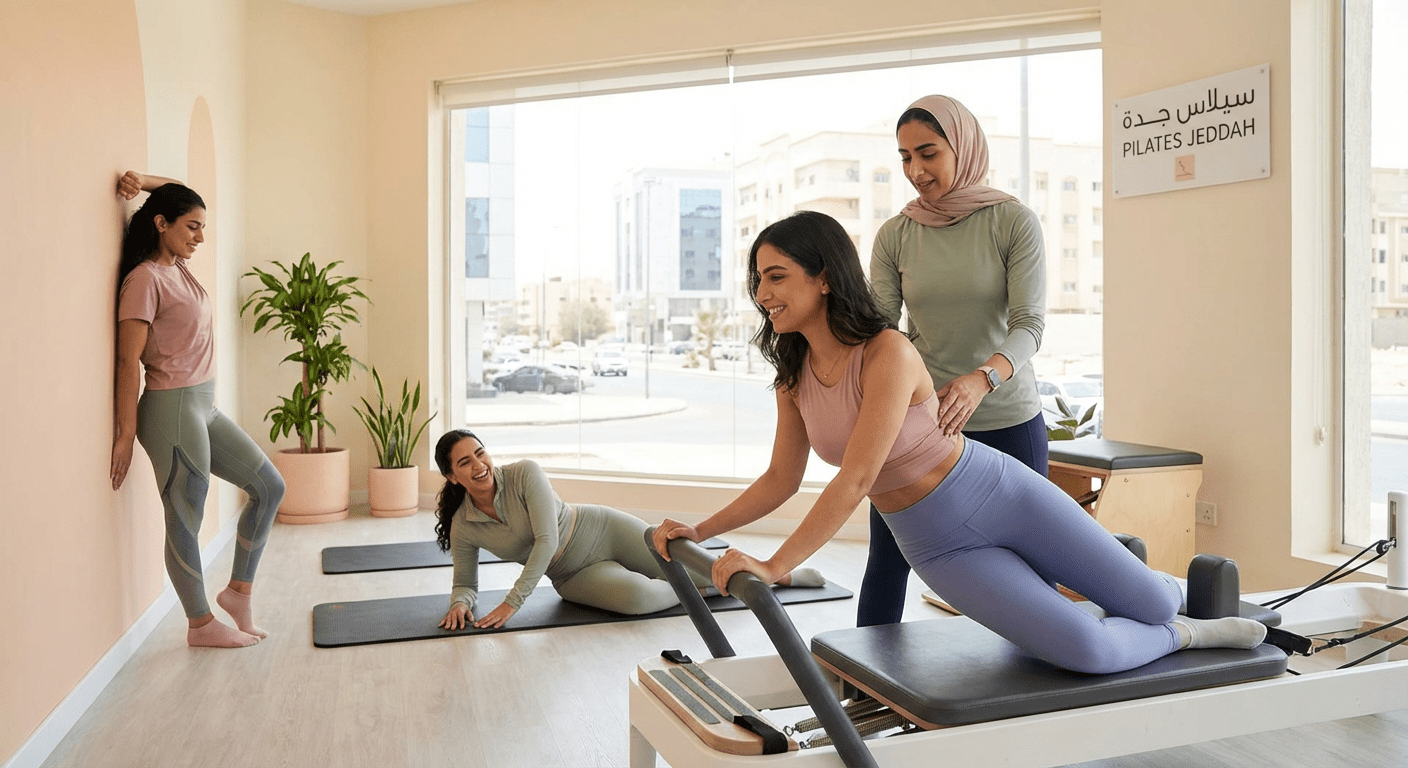
Your environment matters. In Jeddah, the community vibe is a huge part of the experience. Look for a studio that feels welcoming, not intimidating.
Check the schedule: does it align with your energy peaks? Some of us need an evening class to decompress after work, while others need a morning session to start the day right. Visit a few spots. Studios like KARVE, TAMO, Delight Pilates, and Mouv each have distinct approaches—find one where you feel supported by the instructors and the people on the reformers next to you.
What to Expect: Timeline for Mental Health Benefits
One of the most common questions I hear: “How long before I feel different?”
The research provides clear guidance. Studies show noticeable reductions in anxiety and depression symptoms typically emerge after 4-8 weeks of consistent practice at 2-3 sessions per week. Some people report feeling calmer after just three weeks of regular attendance.
A 2024 study confirmed that significant mental health outcomes were achieved with a three-month weekly Pilates program. The key takeaway? Give it time. You might not feel “zen” after one class, but over a month, the cumulative effect is powerful.
Best Practices for Lasting Mental Health Gains
To truly benefit from Pilates mentally, you have to treat it as a practice, not a chore. The mindset you bring into the studio determines what you get out of it.
Here are the keys to making it stick:
Schedule it like a meeting: Put it in your calendar and protect that time
Disconnect: Leave your phone in the locker. No exceptions.
Listen to your body: Modification is not failure; it’s intelligence
Focus on the process: Don’t judge each session. Some days will feel harder than others.
Common Mistakes That Derail Beginners’ Progress
I see so many people start strong in January and vanish by February. Usually, it’s because they fall into predictable traps.
Avoid these pitfalls:
Overtraining: Going from zero to daily classes leads to burnout. Start with 2-3 sessions per week.
Comparison: Don’t look at the person next to you; look at your own form and progress.
Skipping basics: You can’t progress if you don’t know how to engage your core properly. Take foundational classes seriously.
Inconsistency: Sporadic attendance won’t deliver mental health benefits. The research is clear—regular practice is what works.
Practical Considerations for Jeddah Practitioners
Pilates During Ramadan
Many studios in Jeddah adjust their schedules during Ramadan, offering evening classes post-iftar. If you plan to maintain your practice while fasting, opt for low-intensity sessions and listen to your body about shortened durations. The mental benefits of maintaining routine and mindfulness are especially valuable during this time.
Pricing Reality Check
Reformer Pilates classes in Jeddah typically range from 230 to 345 SAR for drop-ins, with package pricing bringing per-class costs down to 160-290 SAR depending on the studio and commitment level. Intro packs (usually 3 classes for around 600 SAR) are the smartest way to test studios before committing to larger packages.
Yes, it’s an investment. But when you frame it as preventative mental health care rather than just exercise, the value becomes clearer.
Real Talk: My Own Journey
I have to be honest—I didn’t get this right immediately. When I first started practicing in Jeddah, I treated it like a boot camp. I booked classes I was too tired to attend, paid late cancellation fees, and beat myself up over missed sessions.
My biggest lesson came during my first Ramadan. I tried to maintain my usual intensity while fasting and crashed hard by day six. I learned that rest days are not lazy days; they are when your body repairs itself.
Now, I view my Pilates practice differently. It’s my sanctuary, not my punishment. I listen to the instructors when they say to slow down. I focus on the “shake” in my muscles as a sign of growth, not pain. Finding a studio that encourages this balance changed everything for me.
Kick Off Your 2026 Pilates Journey Strong
As we look toward 2026, you have the chance to redefine what fitness means to you. It doesn’t have to be about punishment or shrinking your body. It can be about building a mind that is as strong and flexible as your spine.
Start small. Book that first class. Buy a pair of grip socks that make you smile. Whether you are in Jeddah, Riyadh, or anywhere else in the Kingdom, the Pilates community is ready to welcome you.
Let’s make 2026 the year we finally find some peace in the movement.
Frequently Asked Questions
How soon can I expect mental health benefits from Pilates?
Studies show noticeable reductions in anxiety and depression after 4-8 weeks of consistent practice at 2-3 sessions weekly. Many practitioners in Jeddah report feeling calmer and more grounded by week 3 through regular reformer practice and breath control.
Is Pilates suitable during Ramadan in Saudi Arabia?
Yes, many Jeddah studios offer low-intensity evening classes post-iftar. Modify with shorter sessions to avoid fatigue while fasting, maintaining mental benefits through gentle core work and mindfulness. Studios typically adjust schedules to accommodate fasting practitioners.
What’s the cost of starting Pilates in Jeddah for mental health?
Drop-in reformer classes range from 230-345 SAR. Most studios offer intro packs around 600 SAR for 3 classes, which is the best way to start. Regular packages bring per-class costs down to 160-290 SAR depending on commitment level.
Can Pilates help with work stress common in Saudi office culture?
Yes, the lateral breathing and balance exercises specifically target stress reduction by lowering cortisol levels and improving focus. The forced presence required during practice provides a mental break from work pressures, with benefits extending beyond the studio.
Which Jeddah studios are best for mental health beginners?
Studios like KARVE, TAMO, Delight Pilates, and Mouv all offer beginner-friendly classes with certified instructors. The best fit depends on your schedule and preferred atmosphere—visit a few with intro offers to find where you feel most comfortable and supported.
Sources
- 1. Caldwell, K., et al. (2018). The effects of Pilates on mental health outcomes: A meta-analysis of controlled trials. Complementary Therapies in Medicine.
- 2. National Institutes of Health. (2024). Benefits of Pilates on Depression, Anxiety, and Stress: An Observational Study. Healthcare.
- 3. Ju, M., et al. (2023). The impact of Pilates exercise for depression symptoms in female patients: A systematic review and meta-analysis. Medicine (Baltimore).
- 4. Buoli, M., et al. (2024). Is Pilates effective in improving depressive disorders? A comprehensive overview. International Clinical Psychopharmacology.

Leave a Reply