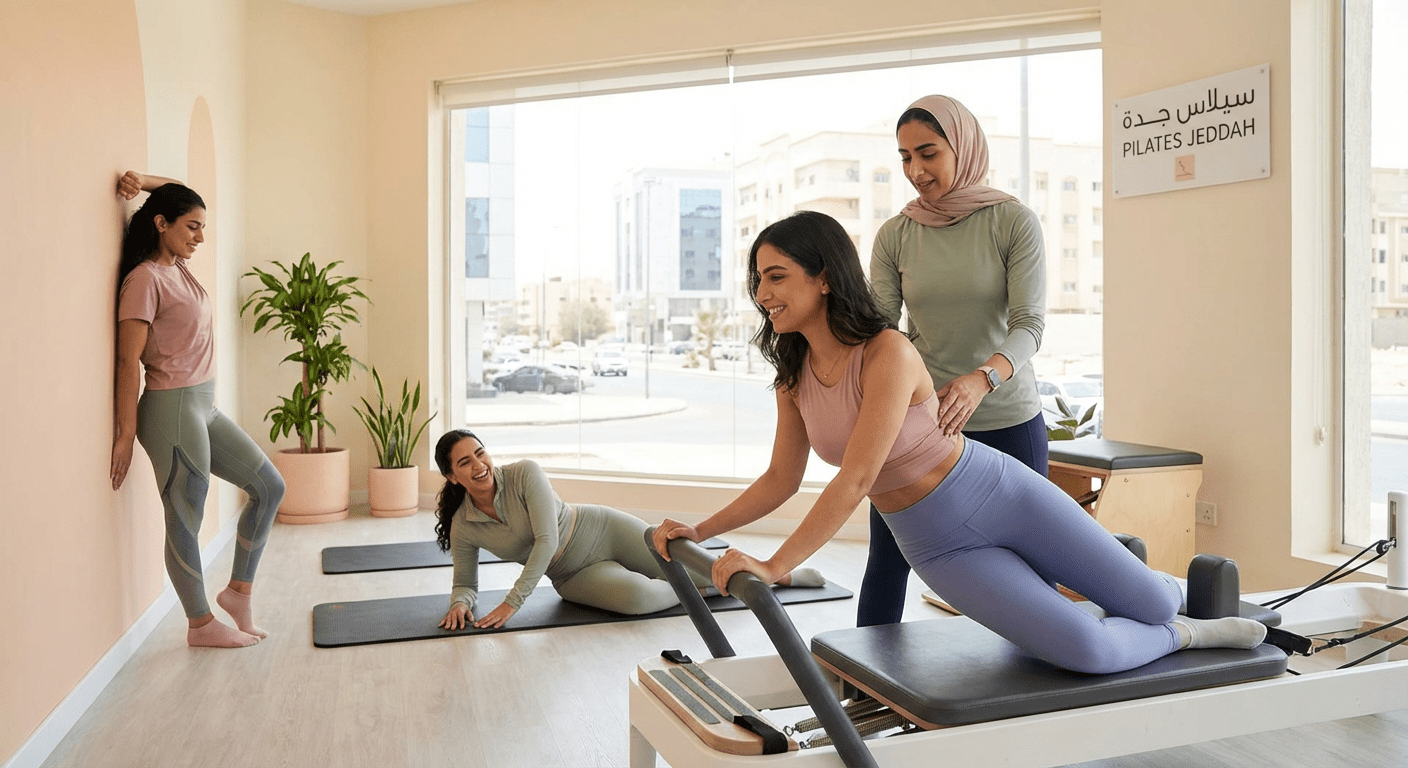
Walking into your first Pilates class in Jeddah doesn’t have to feel overwhelming. This guide walks you through exactly what happens from arrival to cool-down, covering what to wear, common terminology you’ll hear, and realistic expectations for your first 50-minute session. Studios like KARVE offer beginner-specific classes with smaller groups, while understanding the standard class structure helps you show up confident and prepared.
I still remember standing outside my first Pilates studio in Jeddah, checking my phone for the third time to make sure I had the right address. My palms were sweating, and it wasn’t just from the heat. What if I couldn’t keep up? What if everyone else was a pro? What if I looked ridiculous trying to use equipment I’d only seen on Instagram?
Six months later, I can tell you that first class was nothing like I’d imagined. It was harder in some ways, easier in others, and absolutely worth walking through that door. If you’re reading this the night before your first class, taking a deep breath and googling “what actually happens in a Pilates class,” this one’s for you.
Before You Even Walk In: The Practical Stuff
Let’s start with the basics that no one tells you until you’re awkwardly standing in the reception area.
What to Wear (and What Not to Wear)
Wear form-fitting athletic clothes that let you move freely. I learned this the hard way when my oversized T-shirt kept riding up during exercises, and I spent half the class tugging it down instead of focusing on my core. Think leggings or fitted shorts and a sports bra or fitted tank top.
Skip the loose clothing entirely. When you’re lying on a reformer with your legs in the air, baggy clothes become a distraction. Most studios in Jeddah, like KARVE and Delight Pilates, have women-only classes, so you can wear what’s comfortable without worrying about mixed environments.
Grip socks are essential. Regular socks will have you sliding around, and bare feet aren’t ideal for reformer springs. Most studios sell them at the front desk for around 30-50 SAR if you forget yours.
Arrival Time and Check-In
Arrive at least 15 minutes early for your first class. This gives you time to fill out any paperwork, store your belongings, use the restroom, and not feel rushed. Studios typically have you sign a waiver and might ask about injuries or fitness background.
At KARVE Jeddah, for instance, first-timers get a brief equipment orientation before class starts. The instructor will show you how the reformer works, explain the basic positions, and answer any questions. This five-minute overview makes a huge difference in your confidence when class actually begins.
What to Bring
Keep it simple: water bottle, grip socks, hair tie if you have long hair, and maybe a small towel. Leave jewelry at home—rings can catch on straps, and necklaces get in the way when you’re lying on your back.
You don’t need to bring a mat. Studios provide everything you need, whether it’s reformers, mats, or small props like resistance bands and Pilates balls.
The Class Structure: What Actually Happens for 50 Minutes
Most Pilates classes in Jeddah follow a similar structure, whether you’re at a boutique studio or a larger fitness center. Here’s the breakdown:
Warm-Up (5-10 Minutes)
Class starts with gentle movement to prepare your body. You’ll focus on breathing—which feels weird at first because you’re literally thinking about something your body does automatically. The instructor will guide you through inhaling through your nose and exhaling through your mouth in rhythm with simple movements.
Expect exercises like pelvic tilts, spinal articulation, and gentle stretches. This isn’t just filler time before the “real” workout. The warm-up teaches you how to engage your core properly, which is the foundation for everything else.
Don’t worry if you don’t “feel” your core right away. It took me three classes to understand what “draw your navel to your spine” actually meant beyond the words. Be patient with yourself.
Main Workout (35-40 Minutes)
This is where you’ll move through a series of exercises targeting different muscle groups. In a reformer class, you’ll use the machine’s springs for resistance. In a mat class, you’ll work against your own body weight, sometimes with small props.
The movements are slow and controlled. This is not HIIT. You won’t be jumping around or moving fast. The challenge comes from holding positions, making tiny adjustments, and keeping tension in the right places. A 2010 study published in the Journal of Strength and Conditioning Research found that participants in a 12-week Pilates program showed significant improvements in abdominal endurance, hamstring flexibility, and upper-body muscular endurance—proof that slow doesn’t mean easy.
You’ll hear the instructor say things like “neutral spine,” “engage your pelvic floor,” and “find your powerhouse.” Don’t panic if these terms sound like another language. The instructor will demonstrate, and you’ll pick them up as you go.
Cool-Down and Stretch (5 Minutes)
Class ends with stretching and breathing exercises. Some studios, like KARVE, incorporate a mindfulness moment—lights dim, music softens, and you spend a few minutes in stillness focusing on your breath. It sounds cheesy until you experience it, and then it becomes your favorite part.
This isn’t rushed. Take the time to let your heart rate come down and notice how your body feels.
Pilates Terminology You’ll Hear (and What It Actually Means)
Instructors use specific language that can be confusing at first. Here are the terms you’ll hear most often:
The Core: Your abdominal muscles, lower back, and hips. When an instructor says “engage your core,” they want you to gently pull your belly button toward your spine without holding your breath.
Neutral Spine: Your spine’s natural alignment with a slight curve in your lower back. You’re not arching or flattening—just maintaining the natural shape of your spine.
Pelvic Floor: The group of muscles at the base of your pelvis that support your organs. You engage them by gently lifting “up and in” as if you’re stopping the flow of urine. It’s subtle, not a big clench.
Imprint: Pressing your lower back into the mat or reformer, flattening that natural curve. You’ll use this position for certain exercises.
Powerhouse: The area between your ribs and hips, your center of strength. Joseph Pilates called this the powerhouse, and you’ll hear it referenced constantly.
Reformer, Footbar, Springs: The reformer is the sliding machine you lie on. The footbar is where you place your feet or hands. Springs provide resistance—more springs mean more resistance, fewer springs mean less.
You don’t need to memorize this. Just know that when you hear unfamiliar words, the instructor will explain or demonstrate. No one expects you to walk in fluent in Pilates.
What Your Body Will Actually Feel During Class
Let’s be honest about what to expect physically, because it’s not what most people imagine.
You’ll Shake (and That’s Normal)
About 15 minutes in, your legs or arms will probably start shaking. This is completely normal and happens to everyone, even people who’ve been doing Pilates for years. The shaking means your muscles are working hard to maintain control.
When I started shaking in my first class, I thought I was doing something wrong. The instructor walked over and said, “Good—that means you’re in the right position.” It was the most reassuring thing I could have heard.
You Won’t Be Gasping for Air
Unlike running or spin class, Pilates won’t leave you breathless. Your heart rate increases, but the focus is on controlled movement rather than cardiovascular intensity. You’ll be able to breathe normally throughout—in fact, breathing is part of the exercise.
Muscles You Didn’t Know Existed Will Burn
The burn is real, but it’s different from lifting weights. It’s a deep, sustained burn in muscles you’ve probably never felt before. Your inner thighs, the backs of your arms, and especially your deep core muscles will make themselves very known.
This is good. It means you’re working muscles that don’t get much attention in daily life or other workouts.
You’ll Feel Challenged, Not Destroyed
Pilates is hard, but it shouldn’t feel impossible. If an exercise is too difficult, your instructor will offer modifications. Most studios in Jeddah that offer beginner classes, like the ones at KARVE, keep class sizes small (around 12 people) specifically so instructors can give individual attention.
Don’t try to keep up with the person next to you. They might be on their 50th class while you’re on your first. Focus on your own form and movement.
The Jeddah-Specific Experience
Taking Pilates in Jeddah comes with some unique considerations that differ from studios elsewhere.
Women-Only Spaces
Most Pilates studios in Jeddah are women-only, which creates a comfortable environment where you can focus entirely on your workout. You don’t have to think about coverage or who’s watching—just about your movement and breath.
This also means the community feel is strong. Women support each other, celebrate small victories, and create a genuinely welcoming atmosphere for beginners.
Schedule Flexibility Around Prayer Times
Studios structure their schedules around prayer times, which actually works in your favor. Classes typically run morning, afternoon, and evening with breaks built in. Check the schedule online before booking to find times that work with your routine.
Air Conditioning is Your Friend
All studios are well air-conditioned, but if you’re coming from outside during summer, give yourself a minute to adjust to the temperature change before jumping into class. Some people like to arrive extra early just to acclimate.
After Class: What Happens Next
Immediate Aftermath
Right after class, you’ll probably feel energized rather than exhausted. This is one of Pilates’ unique effects—you worked hard, but the low-impact nature means you’re not depleted.
Take a few minutes to hydrate and stretch if you want. Some studios have lounge areas or cafés where you can sit for a bit. At KARVE Jeddah, for example, there’s a café space that members use to relax post-class or meet friends.
The Next Day (Hello, Soreness)
Be prepared for soreness 24-48 hours later. This is called DOMS (delayed onset muscle soreness), and it’s completely normal when you’ve worked muscles in new ways. You’ll feel it in places you didn’t even know you used during class.
The soreness is a good sign—it means your muscles are adapting and getting stronger. Stay hydrated, get enough sleep, and consider gentle movement like walking to help recovery.
Booking Your Next Class
Most studios recommend coming 2-3 times per week as a beginner to build consistency without overdoing it. This gives your body time to recover between sessions while keeping the muscle memory fresh.
Many Jeddah studios offer introductory packages designed for first-timers. KARVE has a 3-class intro pack at 600 SAR, which lets you experience the method before committing to larger packages. Delight Pilates offers similar beginner-friendly options with small group settings.
Common First-Timer Worries (Addressed)
“What if I can’t do an exercise?” You won’t be able to do everything perfectly, and that’s expected. Instructors provide modifications for every single exercise. There’s always a version you can do.
“What if I’m the only beginner?” Even in regular classes, there’s usually a mix of experience levels. Instructors are trained to teach to multiple levels simultaneously. Plus, everyone in that room was a beginner once—they remember what it’s like.
“What if I don’t understand the instructions?” Ask for clarification. Seriously. Instructors would rather you ask than risk injury or frustration. They’re there to help you learn.
“What if I need to take a break?” Take one. There’s no prize for pushing through exhaustion. Listen to your body, rest when you need to, and jump back in when you’re ready.
“What if I look awkward?” You probably will look a little awkward, and so will every other beginner. But here’s the thing—no one is watching you. Everyone is too focused on their own movement to notice if your leg is shaking or if you lost your balance. And the instructor has seen it all before.
How to Get the Most Out of Your First Class
Communicate with your instructor before class starts. Tell them about any injuries, areas of tightness, or specific goals. This takes 30 seconds and makes a huge difference in how they’ll guide you through class.
Focus on form over speed or range of motion. Pilates is about precision, not performance. Doing five perfect movements is better than doing 20 sloppy ones.
Breathe. When exercises get hard, we tend to hold our breath. But breathing is actually part of the exercise in Pilates. If you notice you’re holding your breath, that’s your cue to soften the intensity slightly.
Stay for the entire cool-down. Don’t skip out early. Those final stretches and the mindfulness moment are part of what makes Pilates different from other workouts. They help your body transition back to normal and give you a mental reset.
Be patient with yourself. You’re learning a new movement vocabulary. It takes time to understand what “engage your core” feels like in your own body. Give yourself permission to be a beginner.
The Truth About Your First Class
Your first Pilates class won’t transform your body overnight. Research shows that noticeable physical changes typically appear after 8-12 weeks of consistent practice (2-3 times per week). But what you will feel immediately is the mind-body connection, the satisfaction of learning something new, and probably a healthy dose of muscle soreness the next day.
What surprised me most about my first class wasn’t how hard it was or how much I shook. It was how calm I felt afterward. For 50 minutes, I wasn’t thinking about work or errands or anything except where my body was in space and how it was moving. That mental clarity is what brought me back for class number two, then ten, then fifty.
Walking through that studio door feels intimidating, but on the other side is a community of women supporting each other, instructors who genuinely want you to succeed, and a practice that will challenge you in the best way possible.
Book your first class. Show up 15 minutes early. Wear your grip socks. And give yourself permission to be exactly where you are—at the beginning.
Frequently Asked Questions
Do I need to be flexible to start Pilates?
No. Pilates actually helps you build flexibility over time. You’ll start wherever your body is right now, and the exercises are designed to gradually increase your range of motion. Many people start Pilates specifically because they’re not flexible.
Is Pilates harder than yoga?
They’re different, not necessarily harder or easier. Pilates focuses more on core strength and controlled movement with equipment resistance, while yoga emphasizes flexibility, balance, and holding static poses. Both are challenging in their own ways.
Should I eat before class?
Eat a light snack 1-2 hours before class if you need energy. Avoid heavy meals within 2 hours of class, as you’ll be lying on your stomach and twisting, which isn’t comfortable on a full stomach. A banana or some almonds about an hour before works well for most people.
Can I do Pilates if I have back pain?
Pilates is often recommended for back pain, as it strengthens the muscles that support your spine. However, tell your instructor about your back pain before class so they can offer modifications. If you have a specific injury or chronic condition, check with your doctor first.
What’s the difference between reformer and mat Pilates?
Reformer Pilates uses a machine with springs for resistance and a sliding platform, offering more support and variety in exercises. Mat Pilates uses your body weight and small props like resistance bands or balls. Both are effective; reformer is generally considered more beginner-friendly because the machine provides guidance.
Sources & References
- Kloubec, J. A. (2010). Pilates for improvement of muscle endurance, flexibility, balance, and posture. Journal of Strength and Conditioning Research, 24(3), 661-667. https://pubmed.ncbi.nlm.nih.gov/20145572/
- KARVE Jeddah. (2025). How to Get Started with Reformer Pilates in Jeddah. https://www.einpresswire.com/article/873043714/
- Destination KSA. (2025). Pilates in Jeddah: 9 spots to burn that energy off. https://destinationksa.com/en/pilates-in-jeddah-that-you-have-to-try/
- Delight Pilates Jeddah. (2025). About Delight Pilates. https://www.delightpilates.com/

Leave a Reply