
Choose reformer Pilates for adjustable spring resistance and injury support, or mat Pilates for affordable bodyweight core work doable anywhere in Jeddah. Reformer offers guided movement; mat builds independent stability against gravity. Over 70% of practitioners gain better core strength mixing both within 3 months. Select based on goals, budget, and access for optimal results.
Confused about whether to start with mat or reformer Pilates at a Jeddah studio? Many beginners waste weeks guessing which suits their fitness level, goals, or busy schedule, especially with both options booming in the region. This guide compares their differences, benefits, and real experiences trying both, so you can choose confidently—over 70% of practitioners see better core strength after mixing them within three months.
Why Choose Between Reformer and Mat Pilates?
I remember standing in the lobby of a studio for the first time, staring at the schedule and feeling completely confused. Should I book the class with the intimidating machines or the one on the yoga mats? It’s a common dilemma for anyone starting their wellness journey here in Saudi Arabia.
The truth is, neither is “better” than the other—they just serve different purposes. Your choice depends on your goals, your budget, and what your body needs right now. Here’s a quick breakdown of how they compare:
Factor |
Mat Pilates |
Reformer Pilates |
|---|---|---|
Equipment |
Mat and small props |
Reformer machine |
Cost |
Affordable, low investment |
Higher cost, studio required |
Accessibility |
Can be done anywhere |
Requires studio access |
Intensity |
Bodyweight resistance |
Adjustable spring resistance |
What Is Mat Pilates?
Mat Pilates is exactly what it sounds like—the original method performed on the floor. It’s the foundation of the entire practice. You don’t need fancy gear or a studio membership to get started; you just need a comfortable surface and your own body weight.
According to health experts, Mat Pilates is performed on the ground using a mat for cushioning and requires no special equipment (Healthline).
Here’s what defines the mat experience:
Groundwork: You spend the session lying, sitting, or kneeling on the floor.
Bodyweight Focus: You lift and support your own weight.
Simplicity: No straps, springs, or pulleys to adjust.
What Is Reformer Pilates?
Reformer Pilates takes those foundational movements and adds a mechanical twist. You perform exercises on a bed-like frame called a carriage, which rolls back and forth on wheels. It looks a bit like a medieval torture device at first glance, but I promise it’s actually incredibly supportive.
The magic lies in the springs and straps. These attachments allow you to adjust resistance, making exercises easier for support or significantly harder for a challenge.
Adjustable Resistance: You change the tension to suit your strength.
Elevated Surface: You’re off the ground, which can be easier for people with mobility issues.
Guidance: The machine helps guide your movement path.
How Mat Pilates Works
In a mat class, gravity is your main tool—and your biggest enemy. Because you don’t have a machine assisting you, your muscles have to work double-time to stabilize your body.
The primary focus is on the “powerhouse”—your deep core muscles. You have to control your movements completely on your own. This activates the core in a way that’s sometimes difficult to replicate even on the Reformer, because there are no springs to help you hold a plank or a teaser. It requires your muscles to work against gravity, focusing heavily on stabilization (The Pilates Lab).
How Reformer Pilates Works
The Reformer works by adding external resistance through a system of springs. When you push or pull the carriage, the springs fight back. This creates a unique dynamic where your muscles are working during both the concentric (shortening) and eccentric (lengthening) phases of the movement.
The moving carriage helps maintain proper form and improves workout efficacy and versatility (Fit850).
Why this matters:
Feedback: The ropes provide immediate feedback if one side of your body is weaker.
Versatility: You can do exercises lying down, sitting, standing, or even upside down.
Alignment: The machine structure helps keep your body in good alignment.
Key Differences Between Mat and Reformer Pilates
While both methods share the same principles—breath, concentration, control, and precision—the experience feels vastly different. The main distinction comes down to support versus independence. On the mat, you’re independent; on the Reformer, you’re supported yet challenged by the machine.
Feature |
Mat |
Reformer |
|---|---|---|
Accessibility |
Needs little equipment |
Less ability to modify alone |
Affordability |
Generally cheaper |
Expensive classes/equipment |
Beginner Ease |
Develops foundations |
Adjustable for injuries |
Equipment and Setup
The most obvious difference is the hardware. Mat Pilates requires zero equipment aside from the mat, making it incredibly versatile. You can unroll your mat in your living room in Jeddah or a hotel room while traveling. Reformer Pilates, however, relies entirely on the machine. You generally cannot do it at home unless you have the space and budget for a large piece of apparatus.
Intensity and Resistance
Intensity shows up differently in each method. Mat Pilates burns because you’re holding static positions and fighting gravity without help. Reformer Pilates offers more intensity through spring load. You can add heavy springs to build major leg strength or use light springs to make stability exercises surprisingly difficult. The machine engages various muscle groups through this variable resistance.
Movement Range and Support
The Reformer allows for a greater range of motion. The straps allow you to extend your legs and arms further than you might be able to on the floor. Crucially, the machine acts as a support system.
“The machine acts as a support system for the body and can assist with proper form.” — The Pilates Lab (The Pilates Lab)
Benefits of Mat Pilates for Everyday Practitioners
Mat Pilates is often undervalued, but it’s incredibly effective. It teaches you how to control your body without relying on external props. For me, the mat is where I really learned to breathe and find my “neutral spine.”
Key benefits include:
Body Awareness: You learn to feel exactly where your body is in space.
Core Stamina: Holding a “Hundred” on the mat is arguably harder than on the Reformer.
Practicality: It improves strength, mobility, flexibility, posture, and coordination (The Pilates Lab).
Benefits of Reformer Pilates for Deeper Transformation
If you’re looking to sculpt muscle and change your body composition, the Reformer is a powerhouse. The resistance springs act like weights in a gym but with a focus on lengthening rather than bulking.
It’s also superior for athletic conditioning. A recent 2025 study found Reformer Pilates to be more effective in improving physical capacities in athletes like soccer players compared to other methods (Healthline). The ability to isolate specific muscles makes it ideal for correcting imbalances that we often develop from daily life or other sports.
Factors to Consider When Choosing Mat or Reformer
Deciding between the two often comes down to logistics and physical needs. Here’s a quick guide to help you decide which path fits your current situation:
Group |
Recommendation |
Why? |
|---|---|---|
Pregnant / Elderly |
Reformer |
More modifications available |
Budget Conscious |
Mat |
More affordable classes |
Injury Rehab |
Reformer |
Non-weight bearing options |
Your Fitness Level and Experience
Beginners can start with either, but they offer different learning curves. Mat Pilates is suitable for all levels, but it can be frustrating if you lack core strength, as there’s no assistance. The Reformer allows for an increased challenge with extra springs, but it also allows beginners to start with support.
Mat: Easier to learn the names of exercises and foundational movements.
Reformer: Easier to perform movements correctly due to the machine’s guidance (The Pilates Lab).
Goals and Body Needs
If your goal is rehabilitation, the Reformer is usually the better choice. It allows you to exercise horizontally, removing weight from sensitive joints like knees or ankles. The resistance is also extremely effective for sculpting long, lean muscles without adding bulk. However, if your goal is simply to move more and improve general posture, a daily mat practice at home can be life-changing.
Access and Studio Availability in Jeddah
In Jeddah, access is a major factor. Mat classes are easier to find in general gyms, but specialized Reformer studios offer a different tier of experience.
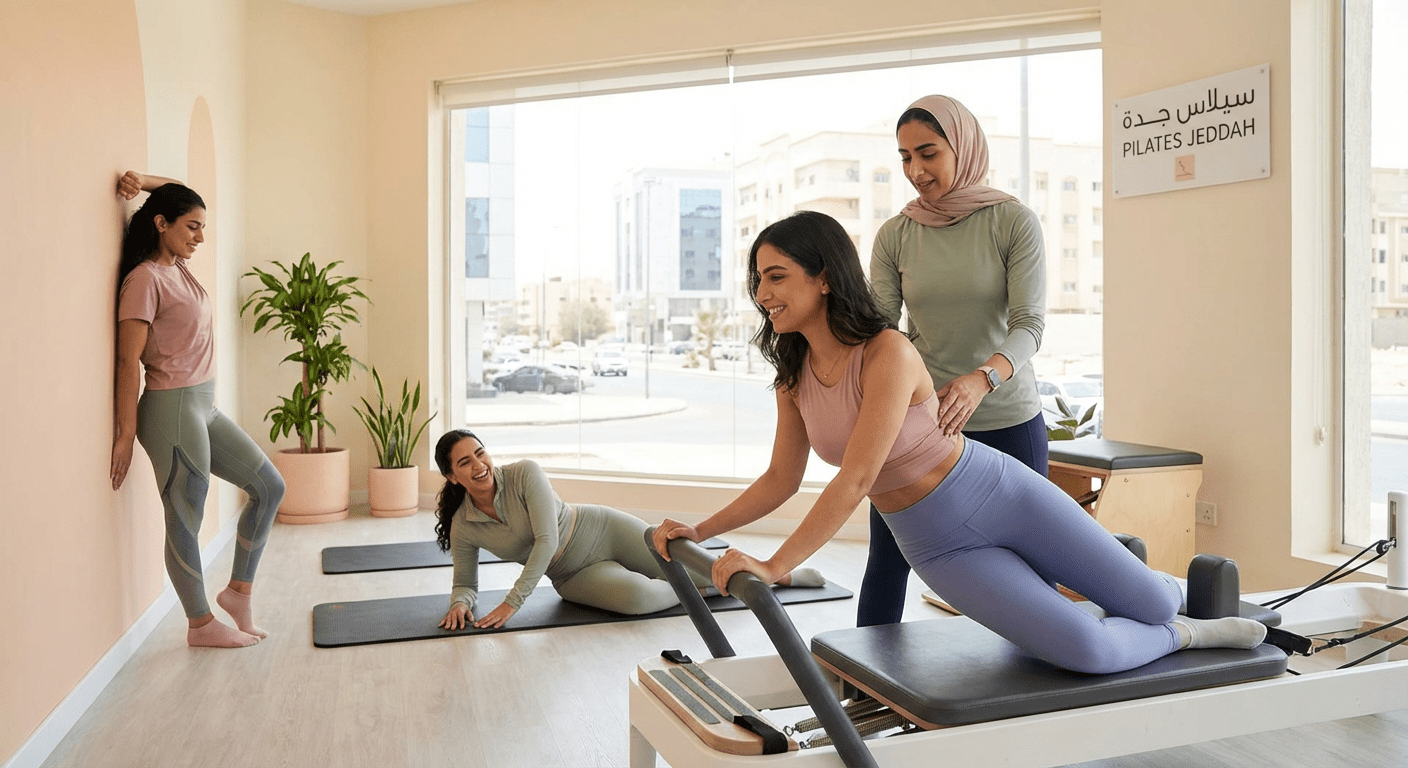
Boutique studios across Jeddah’s Tahlia Street and northern neighborhoods focus heavily on the Reformer experience. Because Reformer requires expensive machines, you have to book specific class times and stick to a schedule. Mat Pilates offers more freedom—you can find online classes or local gym sessions that might fit a flexible schedule better.
My Journey Trying Both in Jeddah
When I first started at my studio in Jeddah, I was all about the Reformer. The machine looked sleek, the studio vibe was incredible, and I loved the idea of “resistance training” without lifting heavy dumbbells.
But here’s the thing: I realized my form was slipping during the tough parts. I started incorporating some mat principles—focusing on my breath and pelvic placement—and suddenly, my Reformer classes got better. The Reformer gave me the strength and the “burn” I love, but understanding the mat fundamentals helped me stay safe. Now, I see them as partners, not competitors.
Common Mistakes When Deciding on Mat vs. Reformer
The biggest mistake is thinking Mat is “easy” and Reformer is “hard.” I’ve sweated more in a 20-minute mat session than in some hour-long gym workouts. Another mistake is jumping into a fast-paced Reformer class without understanding the basics.
“Without the proper guidance of an instructor, you may be using your body in ways that are disadvantageous at best and, at worst, actively harmful.” — RTR Pilates (RTR Pilates)
Don’t assume the machine does the work for you. You have to control the springs; don’t let the springs control you.
Best Practices for Starting Your Pilates Path
Regardless of which method you choose, starting correctly prevents injury and burnout.
Take an Intro Class: It’s highly recommended to attend an Intro to Pilates Class before starting Matwork or Reformer Pilates (The Pilates Lab).
Check Credentials: Ensure your instructor in Jeddah is certified.
Wear Grip Socks: Essential for Reformer safety.
Listen to Your Body: If a spring feels too heavy, ask to lighten it.
Final Thoughts on Mat, Reformer, or Both
You don’t have to pick a side. Many people in the region do both. You might hit a Reformer class at your studio for your heavy resistance days and do a gentle mat flow at home on recovery days.
The “best” Pilates is the one you actually do consistently. Whether you’re on the mat or the machine, you’re building a stronger, more resilient body. So, try both, see what makes you feel good, and keep moving.
Frequently Asked Questions
Are there Reformer Pilates studios in Jeddah?
Yes, Jeddah has several boutique studios offering Reformer classes with certified instructors along Tahlia Street and northern neighborhoods. Expect SAR 100-200 per session; book via studio apps for availability.
Can I do Mat Pilates at home in Saudi Arabia?
Mat Pilates requires only a yoga mat, available at Decathlon Jeddah for SAR 50-100. Follow free YouTube tutorials from certified instructors, practicing 20-30 minutes daily for core strength.
Is Reformer Pilates safe during pregnancy in Jeddah?
Reformer suits pregnancy with adjustable light springs and non-weight-bearing moves. Consult prenatal-certified instructors at local studios; avoid intensive sessions after 32 weeks without medical clearance.
How often should beginners do Mat vs Reformer?
Start with 2-3 sessions weekly for each method; Mat builds independence at home, while Reformer adds resistance at studios. Many practitioners recommend alternating for balanced progress.
What certification do Pilates instructors need in Saudi Arabia?
Instructors should hold STOTT or BASI certification, recognized internationally. Jeddah studios verify credentials; check for 500+ training hours before joining classes.
Sources & References
Healthline. (2024). Reformer vs Mat Pilates: What’s the Difference? https://www.healthline.com/health/reformer-vs-mat-pilates
The Pilates Lab. (2024). Difference Between Reformer Pilates and Matwork Pilates. https://www.thepilateslab.com.au/difference-between-reformer-pilates-and-matwork-pilates/
Fit850. (2024). What’s the Difference Between the Mat and Reformer? https://fit850.com/whats-the-difference-between-the-mat-and-reformer/
RTR Pilates. (2024). The Difference Between Mat vs Reformer Pilates. https://rtrpilates.com/the-difference-between-mat-vs-reformer-pilates/

Leave a Reply